What happens when a city that was never considered a traditional fashion capital decides to create its own Fashion Week? Apparently, you just start writing the plan in the middle of a fashion show.
That is more or less how the story of Alanya Fashion Week began.
For years, the co-founder and producer of the project, Meruyert Shamar, had already been organizing fashion shows, fashion and art festivals and other events in Alanya. She had experience in the industry and had even visited and was one of the organizers of Istanbul Fashion Connection (IFCO). Still, the idea of creating an actual Fashion Week felt different.
People kept asking her the same question: Why don't you make a Fashion Week in Alanya?
The answer, at first, was basically: Can I even do that?
There were questions about permissions, legal requirements and whether organizing a Fashion Week required some kind of secret formula that only the established fashion capitals knew.
Then the director of Azerbaijan Fashion Week gave Meruyert a surprisingly simple answer: yes, it could be done. Legally and organizationally, the process could be approached in much the same way as organizing a festival.
And suddenly, the idea stopped being a “maybe someday” and became a project.
Meruyert remembers writing the first plan during one of the shows she was already organizing. Then came the logo, posters and Instagram account. The idea started becoming something people could actually see.
But very quickly, one thing became obvious: one person cannot build a Fashion Week alone.
The first team eventually fell apart. A new one formed.
Two people, one idea
Maria Ataseven and Meruyert Shamar met at modeling workshop. Maria also had runway experience from Yekaterinburg, as well as connections within the fashion industry. Over time, it became clear that she could bring something different to the project: another perspective, another set of contacts and another kind of experience.
According to Meruyert, Alanya had been asking for a Fashion Week for a while — but previous attempts had not really worked. So Meruyert and Maria decided to stop asking whether someone else would make it happen.
They would make it themselves. They combined their experience, knowledge and connections and launched Alanya Fashion Week together.
And perhaps that is one of the most interesting things about the project: it was not born from some giant fashion corporation or an already established fashion institution. It started with two people deciding that Alanya could have its own place on the fashion map.
So… why Alanya?
Because Alanya is not exactly known for having one single identity.
The city is international, multicultural and constantly changing. People from different countries live, work and spend their summers here. Different languages, cultures, aesthetics and traditions exist side by side. For organizers, that diversity is not something the Fashion Week needs to overcome.
It is the point.
Meruyert herself describes her taste as eclectic — she likes the combination of different styles rather than staying inside one perfectly defined aesthetic. That philosophy eventually became part of the Fashion Week's central concept:
Four Elements.
Water. Earth. Fire. Air.
The elements are not meant to tell designers exactly what their collections should look like. Quite the opposite. They are a starting point. A designer can interpret fire through color, movement or emotion. Someone else might see water as fluid silhouettes. Another designer might take inspiration from earth, history or traditional clothing.
There is room for all of it. And that freedom makes sense in Alanya. Fashion capitals often develop very specific visual identities. Alanya, however, can put minimalism next to maximalism, contemporary design next to ethnic references, and historical inspiration next to something completely experimental.
It does not have to choose one.
Why should fashion?
Not just another pretty runway
Alanya Fashion Week aims for something much more ambitious and practical.
The goal is to build an event that continues after the runway ends—genuinely helping careers where designers meet buyers, models find agents, and participants connect with collaborators. Collections get a real chance to reach actual customers, rather than just appearing for a single show and disappearing.
A key part of this vision involves emerging designers.
By connecting the event with education, students get opportunities to participate in shows and present collections as graduation projects.
Sometimes the biggest obstacle for a young designer is simply having nowhere to start. Alanya Fashion Week wants to be that first step.
Who says fashion has an age limit?
One of the more unexpected parts of the project was its approach to models.
Initially, Meruyert was not completely sure about the idea of including older models. She was concerned about the overall visual image and how the fashion industry might react. Then the casting happened. And the result changed her mind. Partly because Maria insisted at this point. The show included striking, experienced women of different ages, and the audience responded positively — particularly older women who saw people like themselves represented on the runway.
It sent a pretty simple message:
you do not stop being fashionable because you get older.
And you do not have to fit into one specific size, age or type to belong on a runway.
The experience was convincing enough to make age-diverse casting something she wants to continue developing in future editions.
It was not just an idea on paper anymore. And it worked.
From the boutique to the runway
For Shamar, design has been part of her creative life for years, alongside her work as an entrepreneur, boutique owner and event organizer in Alanya.
The idea for this particular collection came with a sense of looking back. In 2004, Meruyert created a collection called “Singing Dunes.” Years later, she considered bringing the collection back for its 20th anniversary, but eventually decided not to recreate it. Instead, she carried some of its ideas forward — especially its connection to nature — and allowed them to evolve into something new, inspired by the landscapes of Alanya.
The collection might not have happened at all without Maria Ataseven, the Fashion Week’s co-organizer. Maria encouraged Meruyert to participate not only as one of the people behind the event, but as a designer presenting her own work. Her encouragement became an important push for Meruyert to turn those long-standing ideas into a new collection.
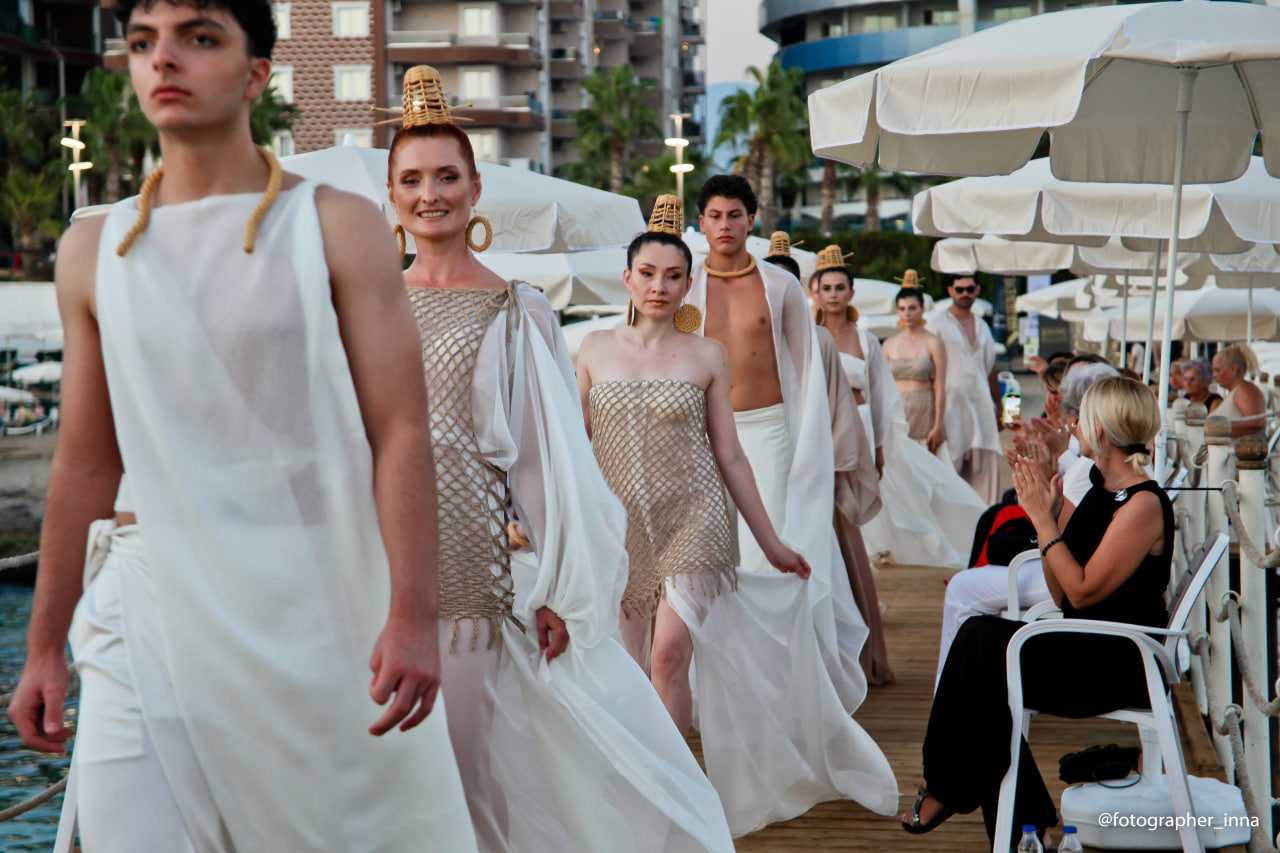
And Alanya itself became one of its main sources of inspiration. Presented on a pier surrounded by the sea and open air, the collection drew from the textures and movement of sand, water and wind. Rather than recreating “Singing Dunes,” Meruyert reinterpreted its spirit through lighter, more fluid silhouettes — designs that seemed to move with the landscape around them.
What comes next?
Alanya Fashion Week is still young. There is no decades-long history behind it. No Parisian legacy. No Milanese fashion district. But maybe that is exactly what makes the project interesting.
It is being built from scratch. Meruyert Shamar and Maria Ataseven are not simply trying to reproduce another city's Fashion Week in a different location. They are trying to figure out what a Fashion Week can look like in Alanya.
One that reflects the city's international character. One that gives young designers a chance. One where models do not have to fit into a single definition of age or beauty. One where a runway can lead to an actual professional connection.
And one where a designer can show a collection inspired by earth, water, fire or air — without being told there is only one correct way to interpret it.
Maybe Alanya does not need to become the next Paris.
Maybe it just needs to be Alanya.
And if Meruyert's original fashion-show notes can turn into a Fashion Week, there is probably a lot more waiting to be written.
interviewed by TSV journal.
One day of Alanya Fashion Week
Dim Medya about Alanya Fashion Week
Fashion Show Studio (talks with participants)